The resonant sound of the ghinang drum inside ancient temples, blending with graceful Cham dances, offers a memorable experience for tourists in Khanh Hoa. Known for its white-sand beaches, Khanh Hoa Province is gradually turning its thousand-year-old Cham culture into a distinct tourism attraction. However, according to tourism experts and travel agencies, this cultural potential remains largely untapped.
A diverse cultural heritage
Associate Professor, Ph.D. Phan Quoc Anh noted that Khanh Hoa possesses a diverse and distinct Cham cultural heritage system. Compared to many localities nationwide, the province holds a major advantage in housing the nation’s largest Cham population, which serves as a living museum of Cham culture.
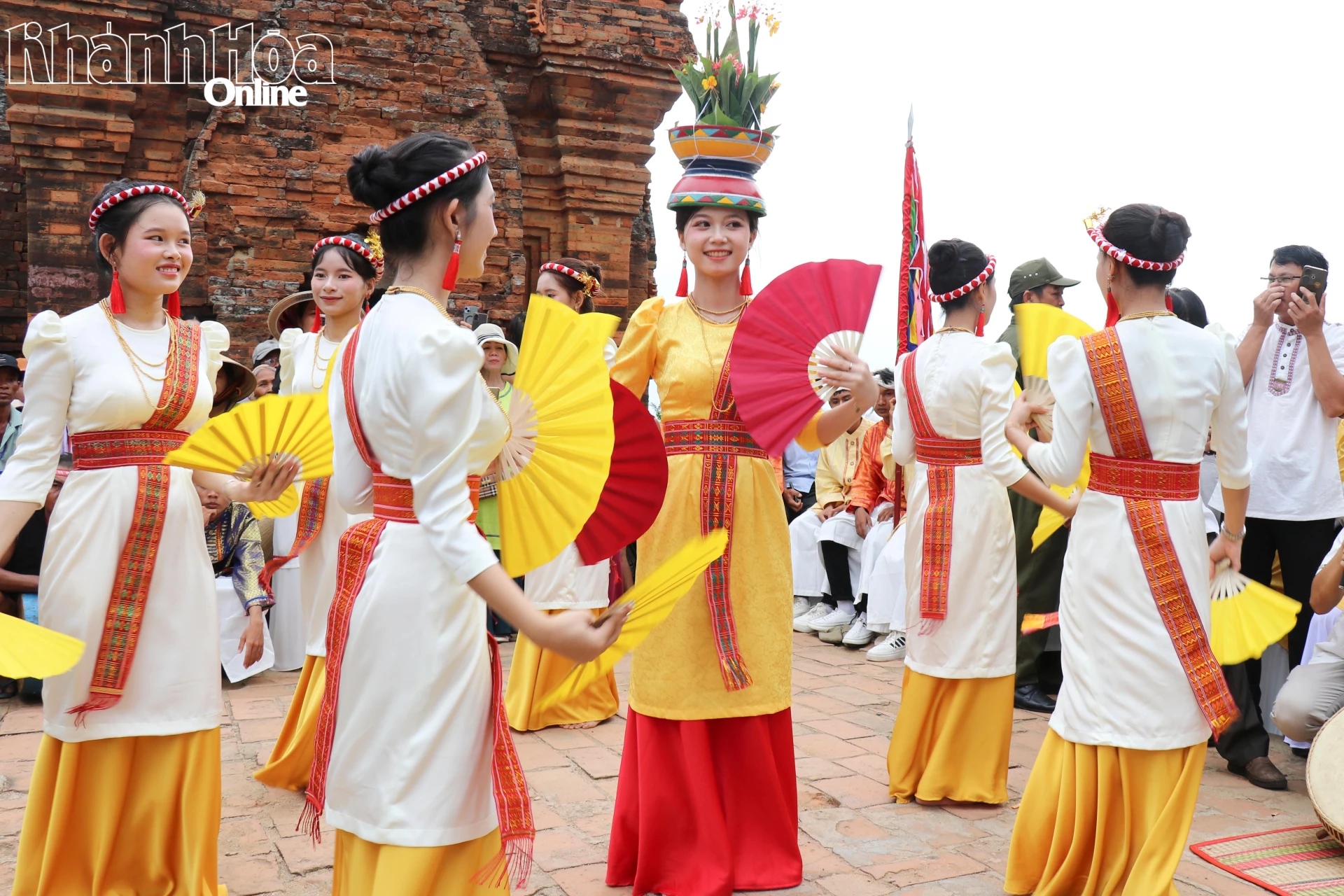
| Cham women performing a traditional dance (Photo: XUAN NGUYEN) |
Khanh Hoa Province boasts a rich treasury of Cham cultural heritage, ranging from thousand-year-old temples and steles bearing the hallmarks of a brilliant civilization to traditional festivals, handicrafts, folk music, and unique culinary culture. Most notable is the system of Cham temples dating back thousands of years. Po Nagar Temple, Po Klong Garai Temple, and Hoa Lai Temple have been classified as special national monument, while Po Rome Temple is recognized as a national monument. Researchers widely consider the temples one of the finest surviving examples of Cham architecture in Vietnam. Hoa Lai stele, the relief of King Po Rome, Phuoc Thien stele, and the worship statue of King Po Klong Garai are national treasures bearing the hallmarks of a once-brilliant civilization.
Alongside tangible monuments, the Cham people’s intangible cultural heritage is equally significant. Kate Festival, featuring the distinct tunes of the saranai flute, traditional dances, and cake-making competitions, and Po Nagar Temple Festival have both been recognized as national intangible cultural heritages. In Bau Truc village (Ninh Phuoc Commune), artisans still hand-mold clay and use traditional open-air firing methods passed down through generations. In 2022, UNESCO inscribed the “Art of pottery making of the Cham people” on the List of Intangible Cultural Heritage of Humanity.
Besides tangible and intangible heritage, Cham cultural heritage boasts folk tales, customs, beliefs, and a distinct culinary tradition preserved across generations. Among these, Ramuwan Festival is the most important event of the year. It is a time for families to reunite, honor ancestors, and pray for peace and prosperity.
Promoting Cham cultural heritage
In recent years, Khanh Hoa Province has taken proactive steps to integrate Cham cultural heritage into its tourism sector. The Po Nagar Temple, a special national monument, has become a popular attraction for millions of domestic and international visitors each year.
| South Korean tourists visit Po Klong Garai Temple |
Recently, many travel companies have launched tours tied to Cham heritage. The tours also include visits to local wind farms, vineyards, Nam Cuong sand dunes, and Vinh Hy Bay, offering a distinct multi-day tourism experience. The mysterious beauty of the thousand-year-old temples captivates both domestic travelers and South Korean visitors. “The architecture here is highly distinct and majestic. Our tour guide explained that the towers were constructed from fired clay bricks bound by a natural adhesive rather than cement, which is truly fascinating,” said Kang Min Jun, a visitor from South Korea.
However, the potential of Cham cultural heritage remains largely untapped. Bui Minh Thang, director of Phuong Thang Trading and Travel Co., Ltd., assessed that currently, only the special national monuments of Po Nagar Temple and Po Klong Garai Temple, and to some extent, Bau Truc pottery village have leveraged their tourism value. Thang proposed developing more Cham spiritual, cultural, and culinary tours. He also suggested introducing traditional Cham costume rental services at the attractions.
Cung Quynh Anh, deputy director of Khanh Hoa Provincial Department of Culture, Sports and Tourism, stated that the province has capitalized on marine and island tourism and resort tourism. Looking toward 2030, the province will prioritize cultural tourism, with a focus on promoting Cham heritage. In the coming time, the department plans to promote promotional campaigns for Cham cultural heritage; coordinate with Khanh Hoa Tourism Association and localities to survey and propose heritage-linked tours; and develop community-based tourism villages for sustainable development.
XUAN THANH
Translated by H.N